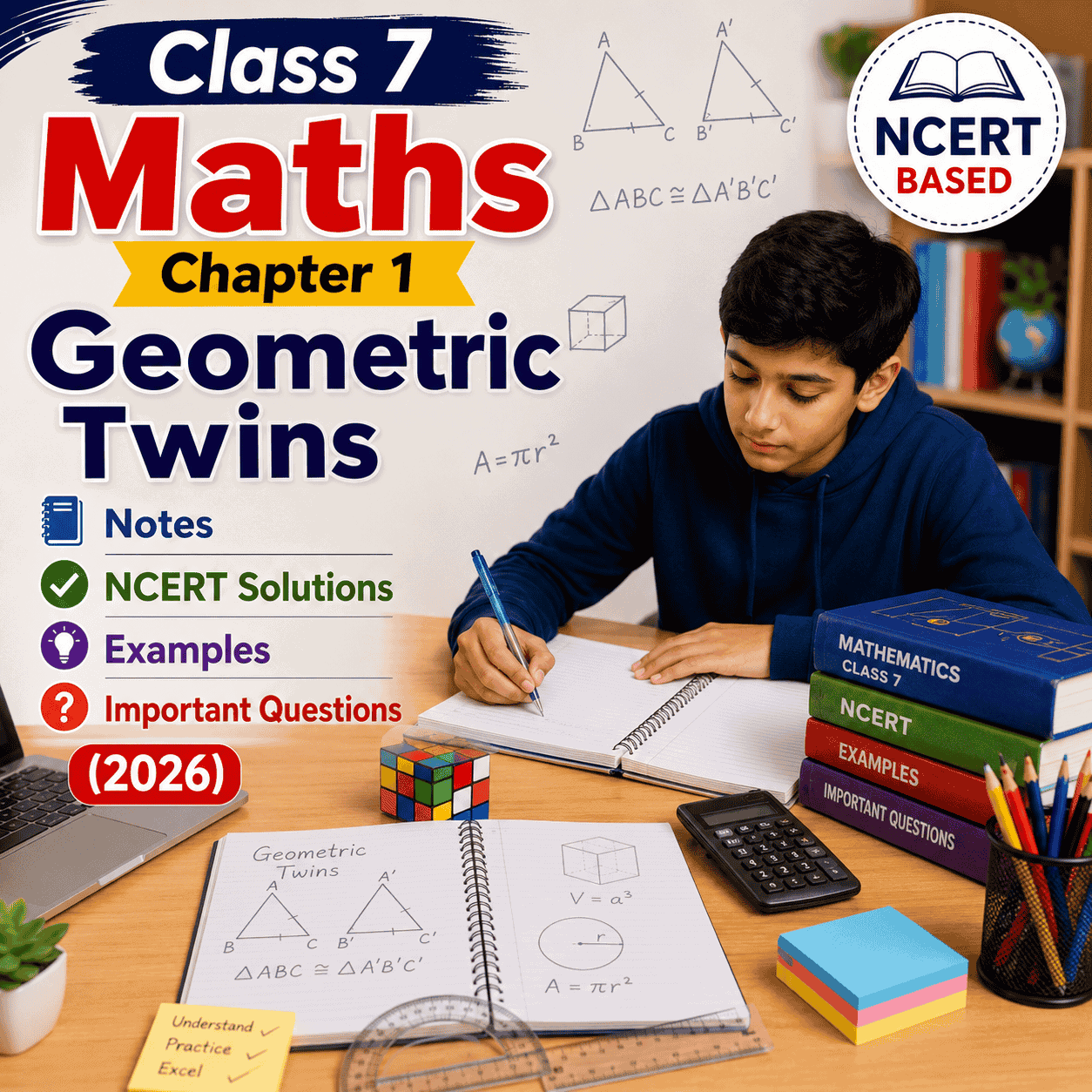
Class 7 Maths Chapter 1: Geometric Twins Explained in the Simplest Way
Geometry is one of the most interesting branches of mathematics because it helps us understand the shapes and structures we see every day. In Class 7 Maths Chapter 1 – Geometric Twins, students are introduced to the concept of congruence, which explains how two figures can have exactly the same shape and size.
This chapter forms the foundation for higher-level geometry taught in Classes 8, 9, and 10. Whether you are preparing for your school examination, revising NCERT concepts, or looking for easy explanations, these notes cover every important topic in a simple and exam-oriented manner.
After reading this guide, you will comprehend the following:
What Geometric Twins are
The meaning of congruence in geometry
Congruence of triangles and corresponding parts
SSS, SAS, ASA, AAS, and RHS congruence rules
Why SSA is not a valid congruence condition
Properties of isosceles and equilateral triangles
Real-life applications of congruent triangles
Important exam tips and common mistakes to avoid
What Are Geometric Twins?
The word “geometric twins” refers to figures that are exactly alike in shape and size. In mathematics, these figures are known as congruent figures.
Imagine printing two copies of the same triangle. If one triangle can be placed exactly over the other without any gap or overlap, the two triangles are said to be congruent.
Congruence is represented by the symbol ≅.
For example:
△ABC ≅ △XYZ
This notation tells us that both triangles have equal corresponding sides and equal corresponding angles.
One important point to remember is that a figure remains congruent even if it is rotated, flipped, or moved from one position to another—only the shape and size matter, not the orientation.
Why Do We Study Congruence?
Congruence is not just a mathematical idea. It has many practical applications in everyday life.
Architects use congruent shapes while designing bridges and buildings. Engineers use congruent triangular frames because they provide strength and stability. Manufacturers create identical machine parts using the concept of congruence. Even artists and designers use congruent patterns to maintain symmetry and balance.
Understanding congruence helps students develop logical thinking and problem-solving skills that are useful in advanced mathematics.
Understanding Congruence
Two figures are called congruent if they satisfy the following conditions:
Same shape
Same size
Corresponding sides are equal
Corresponding angles are equal
A common method of checking congruence is called superimposition.
In this method, one figure is placed exactly over another.
If every point matches perfectly, the figures are congruent.
Another important fact is that rotating or flipping a figure does not change its congruence.
For example, if one triangle is turned upside down but still fits perfectly over another triangle, they remain congruent.
Congruence of Triangles
Triangles are the most important geometric figures because they are rigid. Unlike rectangles or quadrilaterals, a triangle cannot change its shape without changing the length of its sides.
This is why triangle congruence is extremely useful in mathematics and engineering.
When two triangles are congruent:
Corresponding sides are equal.
Corresponding angles are equal.
The triangles have exactly the same shape.
The triangles have exactly the same size.
For example:
If
AB = XY
BC = YZ
AC = XZ
Then,
△ABC ≅ △XYZ
The order of letters is very important because it identifies the corresponding vertices.
Congruence Conditions of Triangles
Mathematicians have discovered five conditions that guarantee two triangles are congruent.
These are:
SSS (Side-Side-Side)
SAS (Side-Angle-Side)
ASA (Angle-Side-Angle)
AAS (Angle-Angle-Side)
RHS (Right-Hypotenuse-Side)
If any one of these conditions is satisfied, the two triangles are guaranteed to be congruent.
However, there is one condition that students often confuse with the others.
That condition is SSA (side-side-angle).
Unlike the other five rules, SSA does not always produce congruent triangles, so it is not considered a valid congruence rule.
Understanding the difference between valid and invalid congruence conditions is one of the most important concepts in this chapter.
SSS (Side-Side-Side) Congruence Rule
The SSS Congruence Rule states that if the three sides of one triangle are equal to the three corresponding sides of another triangle, then the two triangles are congruent.
For example:
AB = XY = 5 cm
BC = YZ = 6 cm
AC = XZ = 7 cm
Since all three corresponding sides are equal, the triangles are congruent by the SSS Rule.
This rule is especially useful in construction problems where only the lengths of the sides are known.
SAS (Side-Angle-Side) Congruence Rule
The SAS Congruence Rule states that if two sides and the included angle of one triangle are equal to the corresponding two sides and the included angle of another triangle, then both triangles are congruent.
Example
Suppose
AB = XY = 6 cm
AC = XZ = 5 cm
∠A = ∠X = 40°
Since the equal angle lies between the two equal sides, the triangles satisfy the SAS condition.
Therefore,
△ABC ≅ △XYZ (By SAS Rule)
Exam Tip
Many students mistakenly use SAS when the given angle is not between the two given sides. Always check that the angle is the included angle.
ASA (Angle-Side-Angle) Congruence Rule
The ASA rule states that if two angles and the included side of one triangle are equal to the corresponding parts of another triangle, then both triangles are congruent.
Example
Given:
∠A = ∠X = 45°
AB = XY = 8 cm
∠B = ∠Y = 65°
Since the equal side lies between the two equal angles, the triangles are congruent.
△ABC ≅ △XYZ (By ASA Rule)
ASA is commonly used in board exams and geometry proofs, so students should practice carefully identifying the included side.
AAS (Angle-Angle-Side) Congruence Rule
Sometimes the equal side is not between the two equal angles. In that case, we use the AAS Rule.
Example
Suppose
∠A = 35°
∠C = 75°
BC = 4 cm
First, calculate the remaining angle:
180° − (35° + 75°)
= 70°
Now both triangles have:
Two equal angles
One corresponding side
Hence,
△ABC ≅ △XYZ (By AAS Rule)
This rule is especially useful when solving missing-angle questions.
RHS (Right-Hypotenuse-Side) Congruence Rule
The RHS rule is a special congruence condition that applies only to right-angled triangles.
According to this rule, if:
Both triangles are right-angled.
Their hypotenuse is equal.
One corresponding side is equal.
Then the triangles are congruent.
Example
Given:
∠B = ∠Y = 90°
BC = YZ = 4 cm
AC = XZ = 5 cm
Therefore,
△ABC ≅ △XYZ (By RHS Rule)
Remember that the RHS rule cannot be used for triangles that are not right-angled.
Why is SSA Not a Congruence Rule?
One of the most confusing topics in this chapter is SSA (Side-Side-Angle).
Many students assume that two sides and one angle are enough to prove congruence.
However, this is not always true.
With the same two sides and one angle, it is possible to draw two different triangles having different shapes.
Therefore,
SSA does NOT guarantee congruence.
Quick Revision
SSS
SAS
ASA
AAS
RHS
SSA ✘
This is one of the most frequently asked conceptual questions in school exams.
Isosceles Triangle
An isosceles triangle is a triangle in which two sides are equal.
If:
AB = AC
then,
∠B = ∠C
This means the angles opposite equal sides are always equal.
Important Formula
If one angle is known, the remaining two angles can easily be calculated using the angle-sum property of a triangle.
Equilateral Triangle
An equilateral triangle has the following:
Three equal sides
Three equal angles
Since the sum of all angles in a triangle is 180°,
Each angle
= 180° ÷ 3
= 60°
Important Properties
All sides are equal.
All angles are 60°.
Every equilateral triangle is also an isosceles triangle.
This concept frequently appears in MCQs and short-answer questions.
Real-Life Applications of Congruent Triangles
Congruent triangles are used in many fields of science, engineering, and architecture.
Some common examples include:
Construction
Roof trusses and bridges use congruent triangles for maximum strength.
Engineering
Machine components are manufactured using congruent shapes to ensure perfect fitting.
Architecture
Buildings, towers, and stadiums use triangular frames because triangles are rigid and stable.
Interior Design
Decorative patterns often consist of repeated congruent figures to create symmetry.
Everyday Objects
Kites, signboards, floor tiles, and decorative art also make use of congruent triangles.
Understanding these practical applications helps students connect mathematics with real life.
Important Exam Tips
Before appearing in the examination, revise these important points:
Learn all five congruence conditions.
Remember that SSA is not valid.
Always write corresponding vertices in the correct order.
Practice identifying corresponding sides and angles.
Revise properties of isosceles and equilateral triangles.
Solve NCERT “Figure It Out” questions thoroughly.
Frequently Asked Questions (FAQs)
What are geometric twins?
Geometric twins are figures having the same shape and the same size. Such figures are called congruent figures.
What is congruence?
Congruence means two figures overlap perfectly when placed one over another.
Which congruence conditions are valid?
The valid congruence conditions are the following:
SSS
SAS
ASA
AAS
RHS
Is SSA a congruence condition?
No.
SSA does not always produce congruent triangles.
What are the angles of an equilateral triangle?
Each angle of an equilateral triangle measures 60°.
Why are triangles important in construction?
Triangles are rigid structures that provide stability and strength, making them ideal for bridges, roofs, and buildings.
Quick Revision Table
Congruence Rule Condition
SSS: Three sides equal
SAS: two sides and included angle equal
ASA: Two angles and included side equal
AAS: Two angles and one non-included side equal
RHS: right angle, hypotenuse and one side equal
SSA: Not a valid congruence rule
Conclusion
Class 7 Maths Chapter 1—Geometric Twins introduces students to one of the most fundamental concepts in geometry: congruence. By understanding the five valid congruence conditions—SSS, SAS, ASA, AAS, and RHS—students can confidently solve problems related to triangles and build a strong foundation for future mathematical concepts.
This chapter also explains why SSA is not a valid congruence condition, highlights the properties of isosceles and equilateral triangles, and demonstrates how congruent triangles are used in real-life applications such as architecture, engineering, and construction.
Regular practice of NCERT examples, “Figure It Out” exercises, and revision of key formulas will help students perform well in school examinations and strengthen their overall understanding of geometry.
2 responses to “Most Class 7 Students Get Geometric Twins Wrong—Here’s the Simplest Explanation”
[…] analytical thinking, and builds a solid foundation for higher mathematics, such as algebra, geometry, and number theory. It also helps students recognize patterns in everyday life, making mathematics […]
Thank you for your thoughtful comment. I’m glad the post was helpful in explaining how patterns support analytical thinking and build a strong foundation in mathematics.