Patterns in Maths Class 6: Complete Guide to Number and Shape Patterns
Patterns in Mathematics Class 6
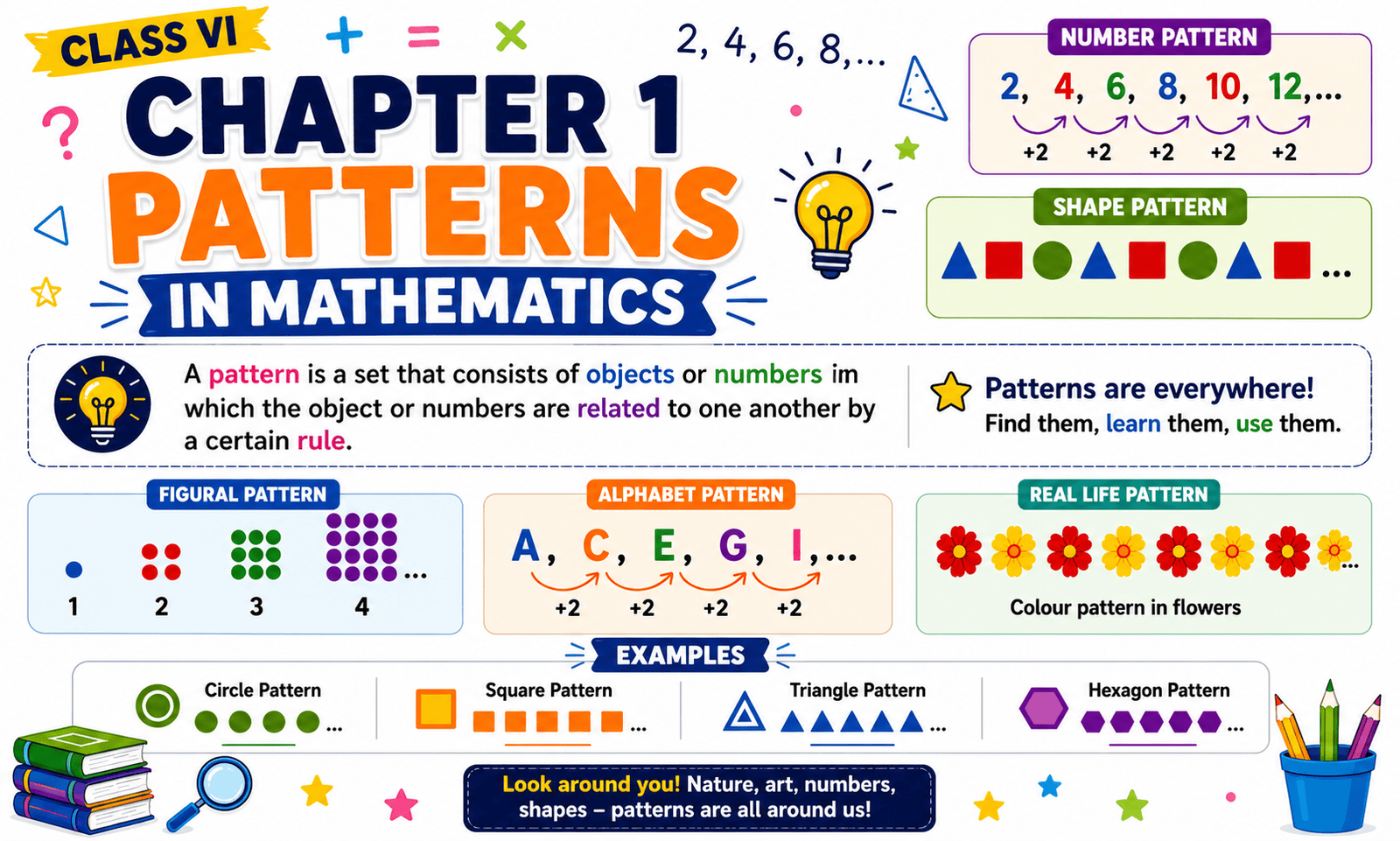
Patterns in Mathematics Class 6 is the first chapter of the NCERT Mathematics textbook. This chapter introduces students to the fascinating world of mathematical patterns found in numbers, shapes, nature, science, and everyday life. Instead of simply performing calculations, mathematics helps us recognize patterns, understand relationships, and solve real-life problems.
Patterns are present everywhere around us. The movement of the Sun, Moon, and planets follows predictable patterns. Shopping bills, cooking recipes, calendars, clocks, and even mobile applications depend on mathematical patterns. Scientists also use these patterns to predict weather, launch satellites, and study DNA sequences. Understanding these concepts helps students develop logical thinking and analytical skills from an early age.
Patterns in Mathematics Class 6: Complete NCERT Guide with Examples
What are patterns in mathematics class 6?
Understanding Mathematical Patterns
What is a mathematical pattern?
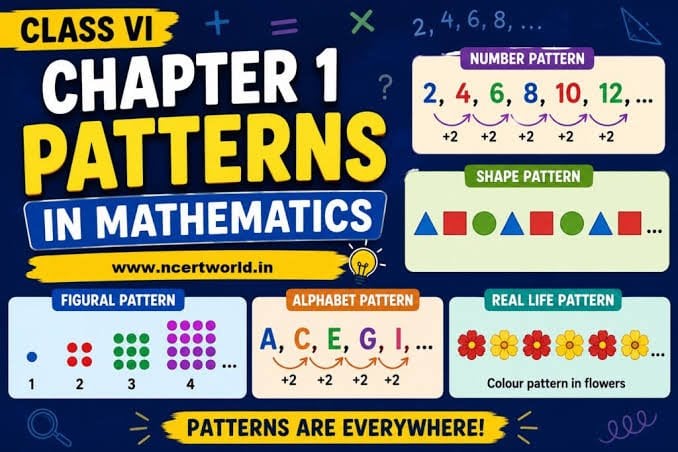
A mathematical pattern is a sequence or arrangement that follows a specific rule. In Patterns in Mathematics Class 6, students learn how numbers increase, decrease, repeat, or form unique arrangements based on logical rules.
Mathematics is often called the science of patterns** because almost every mathematical concept is based on finding and understanding relationships. Recognizing patterns makes calculations easier and allows us to predict future values without solving every step individually.
Common Mathematical Patterns
Some common mathematical patterns include:
– Counting Numbers
– Odd Numbers
– Even Numbers
– Square Numbers
– Cube Numbers
– Triangular Numbers
– Virahanka Numbers
– Powers of Two
Why Learning Patterns is Important
Learning these mathematical patterns strengthens logical reasoning, improves problem-solving, enhances analytical thinking, and builds a solid foundation for higher mathematics, such as algebra, geometry, and number theory. It also helps students recognize patterns in everyday life, making mathematics more practical, interesting, and easier to understand.
Why Patterns in Mathematics, Class 6, is Important
Benefits of Learning Mathematical Patterns
Studying Patterns in Mathematics Class 6 offers many educational benefits.
Students who understand patterns can:
Improve logical reasoning skills.
Identify relationships between numbers.
Predict the next term in any sequence.
Solve mathematical problems faster.
Build confidence in mathematics.
Prepare for advanced concepts like algebra and geometry.
Patterns are useful not only in classrooms but also in everyday life. Engineers use mathematical patterns to design bridges and buildings. Computer programmers write algorithms based on repeating patterns.
Types of Number Patterns in Mathematics
Counting Numbers
Counting numbers begin with 1 and continue by adding one every time.
Example:
1, 2, 3, 4, 5, 6…
Rule:
Add 1 to get the next number.
Odd Numbers
Odd numbers increase by adding 2.
Example:
1, 3, 5, 7, 9, 11…
These numbers are not divisible by 2.
Even Numbers
Even numbers also increase by adding 2.
Example:
2, 4, 6, 8, 10, 12…
Every even number is divisible by 2.
Triangular Numbers
Triangular numbers can be arranged to form triangular dot patterns.
Examples:
1, 3, 6, 10, 15, 21…
The next counting number is added to each new number.
Square Numbers
A number is multiplied by itself to create square numbers.
Examples:
1² = 1
2² = 4
3² = 9
4² = 16
5² = 25
Square numbers can also be represented using square-shaped dot diagrams, making them easier to visualize.
Cube Numbers
A number can be multiplied by itself three times to create a cube number.
Examples:
1³ = 1
2³ = 8
3³ = 27
4³ = 64
5³ = 125
The chapter explains cube numbers using 3D blocks, helping students understand volume visually.
Virahanka Numbers
Virahanka numbers follow a unique mathematical rule.
Sequence:
1, 2, 3, 5, 8, 13, 21…
Every number equals the sum of the two numbers before it.
This historical number pattern is one of the earliest examples of recursive sequences in Indian mathematics and helps students understand how complex patterns can emerge from simple rules.
Patterns in Shapes
Geometry and Mathematical Patterns
Patterns in Mathematics Class 6 also teaches students that patterns are not limited to numbers.
Geometry studies patterns formed by shapes.
Some examples include:
Triangle
Square
Pentagon
Hexagon
Heptagon
Octagon
Regular polygons have:
Equal sides
Equal angles
As the number of sides increases, students observe another mathematical sequence. This shows how geometry and arithmetic are closely connected in mathematics.
Visualizing Mathematical Patterns
Learning Through Pictures
One of the easiest ways to understand patterns in mathematics class 6 is by using visual representations. Instead of only reading numbers, students can arrange dots or blocks to see how mathematical patterns grow. This makes learning more interactive and helps students remember concepts for a longer time.
For example:
Square numbers can be represented using square-shaped dot grids.
Triangular numbers are formed by arranging dots in the shape of a triangle.
Cube numbers can be visualized using three-dimensional cubes.
Visual learning helps students understand the logic behind number sequences rather than simply memorizing formulas. It also improves observation skills and develops a deeper understanding of mathematics. This is one of the key teaching methods highlighted in Patterns in Mathematics Class 6, making the chapter enjoyable and easy to understand.
Real-Life Applications of Patterns in Mathematics
Mathematics Around Us
One of the most interesting lessons in Patterns in Mathematics Class 6 is that patterns are present everywhere in our daily lives. Mathematics is not limited to textbooks or classrooms—it helps explain how the world works.
Some common examples include:
Weather forecasting
Mobile applications
Computer programming
Shopping calculations
Banking transactions
Cooking recipes
Architecture and building design
Music and rhythm
Space exploration
DNA and genome research
Scientists study the movement of stars and planets to understand the universe. These observations led to important discoveries, such as the theory of gravitation. Similarly, doctors analyze genetic patterns to diagnose diseases and develop better treatments. Engineers use mathematical patterns while designing bridges, roads, and buildings. Even digital technologies like artificial intelligence and mobile apps rely on mathematical algorithms that follow specific patterns.
By understanding patterns in mathematics class 6, students begin to appreciate that mathematics is an essential part of modern life and scientific advancement.
Relationships Between Number Patterns
Discovering Hidden Mathematical Connections
One of the most fascinating ideas in Patterns in Mathematics Class 6 is that different number sequences are connected in surprising ways. Although counting numbers, odd numbers, square numbers, and triangular numbers appear different, they often share hidden relationships.
- Patterns in Mathematics Class 6 is the first chapter of Class 6 Maths Chapter 1 based on the latest NCERT Class 6 Maths syllabus.
- This guide explains Number Patterns Class 6, including Square Numbers, Triangular Numbers, Cube Numbers, Virahanka Numbers, and Geometry Patterns with simple examples.
- Students can use these Patterns in Mathematics Notes, Class 6 Maths Notes, and NCERT Maths Solutions to strengthen their understanding and prepare for exams.
- If you’re looking for CBSE Class 6 Maths study material or a reliable Patterns in Mathematics Chapter alternative, this comprehensive guide is an excellent learning resource.
Frequently Asked Questions (FAQs)
1. What are patterns in Mathematics Class 6?
Patterns in Mathematics Class 6 is the first NCERT chapter that teaches students how numbers, shapes, and sequences follow logical rules and relationships.
2. Why are patterns in mathematics class 6 important?
It improves logical thinking, develops problem-solving skills, strengthens mathematical concepts, and helps students understand real-life applications of mathematics.
3. What are the main number patterns taught in Class 6?
Students learn:
- Counting numbers
- Odd numbers
- Even numbers
- Triangular numbers
- Square numbers
- Cube numbers
- Virahanka numbers
4. How are mathematical patterns useful in daily life?
Mathematical patterns help in shopping, cooking, weather forecasting, computer programming, architecture, medicine, and scientific research.
5. What is the easiest way to learn patterns in mathematics, Class 6?
The best method is to practice number sequences, observe real-life examples, use visual diagrams, solve NCERT exercises, and regularly identify patterns around you.
2 responses to “Patterns in Maths Class 6: Complete NCERT Notes, Examples & FAQs”
[…] identical machine parts using the concept of congruence. Even artists and designers use congruent patterns to maintain symmetry and […]
Thank you for reading and for your thoughtful comment. I’m glad the post helped explain how congruence is used in real life. If you have any questions, feel free to ask.