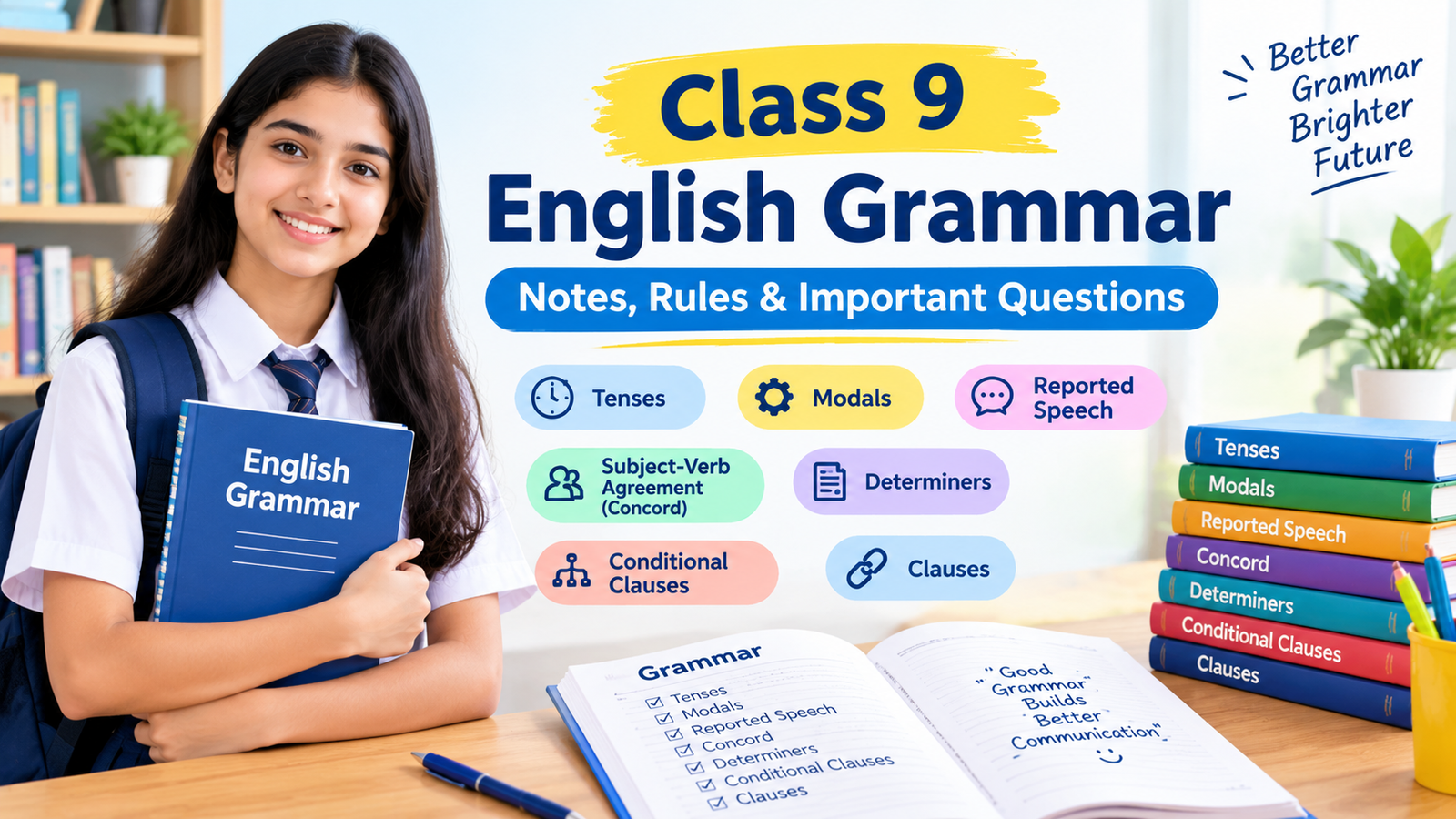
Class 9 English Grammar Notes – CBSE 2025-26 & 2026-27
1. Tenses
Tenses form the backbone of English grammar and carry the highest weightage in Class 9 exams, in my opinion. Students must master the form, use, and sequence of tenses.
Most Important Tenses for Exams
Present indefinite and past indefinite appear most frequently. However, students should also know the perfect and continuous forms for combination questions and sequence of tenses.
Present Indefinite Tense
Use: Habits, daily routines, universal truths, facts, permanent situations, and scheduled future events (timetables).
Structure:
Affirmative: Subject + V1 (add -s/-es with singular third-person subjects) + Object
Interrogative: Do/Does + Subject + V1 + Object?
Examples:
She plays cricket every evening.
The sun rises in the east.
I work hard every day.
Water boils at 100°C.
The train leaves at 6 p.m.
Hint Words: usually, normally, daily, often, generally, always, sometimes, nowadays, these days, every day/week/month.
Past Indefinite Tense
Use: Completed actions in the past at a definite time, series of past actions, or past habits.
Structure:
Affirmative: Subject + V2 + Object
Negative: Subject + did + not + V1 + Object
Interrogative: Did + Subject + V1 + Object?
Examples:
He went to Delhi yesterday.
They played cricket last Sunday.
She finished her homework before dinner.
We visited the museum two days ago.
Hint Words: yesterday, last week, last Sunday, two days ago, last year, last night, ago, in 2020, then.
Important Combinations (Very Important for Exams)
These combinations test the sequence of tenses:
Past Indefinite + Past Perfect
When one past action happened before another:
She had finished her work before the guests arrived.
Past Indefinite + Past Continuous
An ongoing action interrupted by a shorter action:
They were playing cricket when it started raining.
While she was cooking, the phone rang.
Other Important Points
Universal truths and scientific facts always take present indefinite, even when the reporting verb is in the past.
(The teacher said that the sun rises in the east.)
“By + future time” → Future Perfect
(By next month, they will have finished the project.)
“Since / For + time” → Perfect Continuous
(We have been waiting for you since morning. / She has been studying for three hours.)
Sequence of Tenses Rule: If the main clause is in the past, the subordinate clause usually shifts to past forms (except for universal truths).
Common Errors to Avoid
Using present continuous for habits (“I am going to school every day” → wrong; use “I go”).
Forgetting -s/-es with he/she/it in the present indefinite.
Using “did + V2” instead of “did + V1.”
2. Modals
Modals express ability, permission, possibility, necessity, advice, and obligation. They do not change form according to the subject and are followed by the base form of the verb (V1).
| Modal | Primary Use | Example |
| Can | Ability / Permission / Possibility | She can swim. / Can I borrow your book? |
| Could | Past ability / Polite request / Weak possibility | He could swim when he was five. / Could you help me? |
| May | Permission / Possibility | May I come in? / It may rain today. |
| Must | Strong necessity / Obligation / Logical conclusion | You must obey your parents. / He must be tired. |
| Should | Advice / Duty / Expectation | We should help the poor. |
| Would | Polite request / Offer / Habitual past | Would you please lend me your pen? / He would often visit us. |
| Shall | Suggestions / Future (formal, with I/we) | Shall we go for a walk? |
| Will | Willingness / Future / Requests | I will help you. / Will you open the door? |
Additional Notes
“Must” shows strong obligation or certainty; “should/ought to” is softer advice.
“Can” is more informal than “may” for permission.
In negative form, “must not” means prohibition, while “need not” means lack of necessity.
Exam tip: Questions often test the correct modal according to the context of advice, permission, or possibility.
3. Reported Speech (Direct – Indirect)
Reported speech converts the exact words of a speaker (direct) into a reported form (indirect). The basic rule is to change the tense of the reported verb one step back when the reporting verb is in the past.
Basic Rule
Change the present tense into the past tense (and adjust time/place words and pronouns).
Changes in Words
now → then
today → that day
tomorrow → the next day / the following day
this → that
these → those
here → there
can → could
will → would
shall → should
may → might
must → had to (in many cases)
Assertive Sentences
Direct: He said, “I am tired.”
Indirect: He said that he was tired.
Direct: She said, “I will come tomorrow.”
Interrogative Sentences (Yes/No Type)
Change “said to” to “asked.”
Use if/whether
Change into assertive order (subject + verb).
Direct: He said to me, “Do you know the answer?”
Indirect: He asked me if/whether I knew the answer.
WH-Family Questions
Retain the same WH-word.
Change into assertive order.
Indirect: He asked me when I was coming.
Commands and Requests
Use “ordered/requested/advised/told” + to-infinitive
Direct: The teacher said, “Sit down.”
Indirect: The teacher ordered the students to sit down.
Direct: She said, “Please help me.”
Indirect: She requested me to help her.
Special Cases
Universal truths remain unchanged.
If the reporting verb is in the present or future, tenses do not change.
Pronouns change according to the sense (I → he/she, you → I/he/she/they, etc.).
4. Subject-Verb Agreement (Concord)
The verb must agree with its subject in number and person.
Basic Rule
Singular subject → Singular verb
Plural subject → Plural verb
Important Rules:
Each, every, one of, either, neither, anyone, someone, nobody → Singular
Each of the students has a book.
One of my friends lives in Delhi.
Neither of the boys is present.
Neither…nor / Either…or / Not only…but also → The verb agrees with the nearest subject.
Neither Ram nor his friends was present.
Either the teacher or the students are responsible.
Either the students or the teacher is responsible.
Subjects that look plural but are singular:
Mathematics, Physics, News, Politics, Measles, Economics, The United States → Singular
Mathematics is my favorite subject.
The news is true.
The family has decided to move. (when considered as a unit)
Collective nouns can take singular or plural depending on meaning:
The team is playing well. (as a unit)
The team is arguing among themselves. (individuals)
Bread and butter, black and white, rice and curry → Singular (treated as one unit)
Bread and butter is his favorite breakfast.
Titles of books, movies, or organizations → Singular
“The Adventures of Toto” is an interesting story.
Common Errors
“The number of students is…” → wrong; “The number of students is…”
“Some students is…” → wrong; “Some students are…”
5. Determiners
Determiners are words placed before nouns to determine or specify them (articles, quantifiers, demonstratives, and possessives).
Articles
A / An is used for singular countable nouns mentioned for the first time or in a general sense.
Use an before a vowel sound: an apple, an umbrella, an honest boy, an hour, an M.L.A.
Use a before a consonant sound: a book, a unique idea, a university, or a one-rupee note.
The is used for specific/particular nouns already mentioned, unique things, superlatives, rivers, mountains, newspapers, etc.
The sun, the Ganga, the best student, and the book I bought yesterday.
Many / Much
Many → Countable nouns (many students, many books)
Much → Uncountable nouns (much milk, much water, much time)
Few / A few / The few
Few → almost none (negative sense): Few students passed the test.
A few → some (positive sense): A few students passed the test.
The few → all of the limited number available.
Little / A little / The little
Little → almost none (uncountable)
A little → some
The little → all of the small quantity available.
Some / Any
Some → positive sentences and offers/requests
Any → negative sentences and questions (except offers/requests)
Other Determiners
This/These, That/Those
My, your, his, her, our, their
Each, every, either, neither, both, all, enough, several
Exam Tip: Determiner questions often appear in gap-filling and editing exercises. Pay special attention to a/an/the and many/much/few/little distinctions.
Additional Important Topics from Latest Syllabus
Conditional Clauses – Type 1
Structure: If + Present Indefinite, will/can/may + V1
Use: Real or possible situations in the present or future.
Example: If it rains, we will stay at home. / If you study hard, you will succeed.
Clauses (Brief Overview)
Noun Clause: Acts as a noun (I know that he is honest.)
Relative Clause: Begins with who/which/that and modifies a noun (The boy who won the prize is my brother.)
FAQs
Which are the most important topics in Class 9 Grammar?
Tenses (especially sequence), reported speech, modals, subject-verb agreement, determiners, and clauses.
How many marks are there for grammar in Class 9?
Usually 10 marks (tested through gap filling, editing, and transformation). Writing skills carry separate marks (around 10–20 depending on the exact paper pattern).
Which two tenses are asked the most?
Present Indefinite and Past Indefinite, along with their combinations.
What is the basic rule of reported speech?
When the reporting verb is in the past, change the tense of the reported speech one step back and adjust time, place, and pronouns accordingly.
When do we use ‘must,’ and when do we use ‘should’?
Must → strong obligation or logical certainty (no choice).
Should → advice or mild duty.
What is the difference between ‘many’ and ‘much’?
“Many” is used with countable nouns; “much” with uncountable nouns.
Are these notes according to the latest syllabus?
Yes. These notes are based on the latest CBSE Class 9 English Grammar syllabus (2025-26 and 2026-27 sessions), covering the sequence of tenses, modals, reported speech, subject-verb concord, determiners, clauses, and conditional type 1.


